Rise to Wellness is designing, validating, and deploying the World Mental Health Curriculum: a comprehensive program that teaches children the practical skills to manage emotions, build relationships, and navigate life. Every part of our model is built so that no school has to choose between adopting it and balancing its budget.
Most school-based mental health programs fail at one of two points: they're too expensive for schools to adopt, or they have no way of proving they worked. Our model is built to clear both bars from day one.
Six modules covering 31 evidence-based life skills, written in-house and reviewed by outside academic researchers before deployment.
Schools and students pay nothing. Parents and community members raise funds locally to hire teachers, who become Rise to Wellness employees.
Teachers are recruited from the community they'll serve and undergo a structured two-month training program: eight Saturday sessions, eight hours each, led by our development team and Executive Director. They're then supported with teacher-ready lesson packets, one-page scripts, and printed workbooks and worksheets for the children.
Pre- and post-assessment using validated psychometric instruments. Children encounter the curriculum at least three times across their school years to deepen learning.
Mental health curricula already exist. Most don't reach the children who need them most because schools, particularly in lower-income districts and developing countries, can't afford to buy them, train teachers, or carve out instructional time.
We solve this by removing every cost a school would normally bear. Adoption requires no purchase, no per-student license, no teacher hiring. The community that wants the program for its children raises the money to fund the teacher; we hire and train that teacher; the school provides the classroom. Everyone wins, and no school has to wait for a budget cycle.
And because the teacher is our employee, not a school staff member assigned an extra duty, we can guarantee fidelity to the curriculum and accountability for outcomes.
Compare what Rise to Wellness builds against the typical model for school-based mental health programs.
We're deliberately starting in two very different settings, a high-income urban context and a developing-country context, to demonstrate that the program works across cultures and resource environments.
Rise to Wellness is incorporated as a 501(c)(3) in Massachusetts. Boston gives us proximity to world-class research partners (Tufts, Harvard, BU, McLean) and a dense network of community centers and faith-based organizations that can host pilot cohorts.
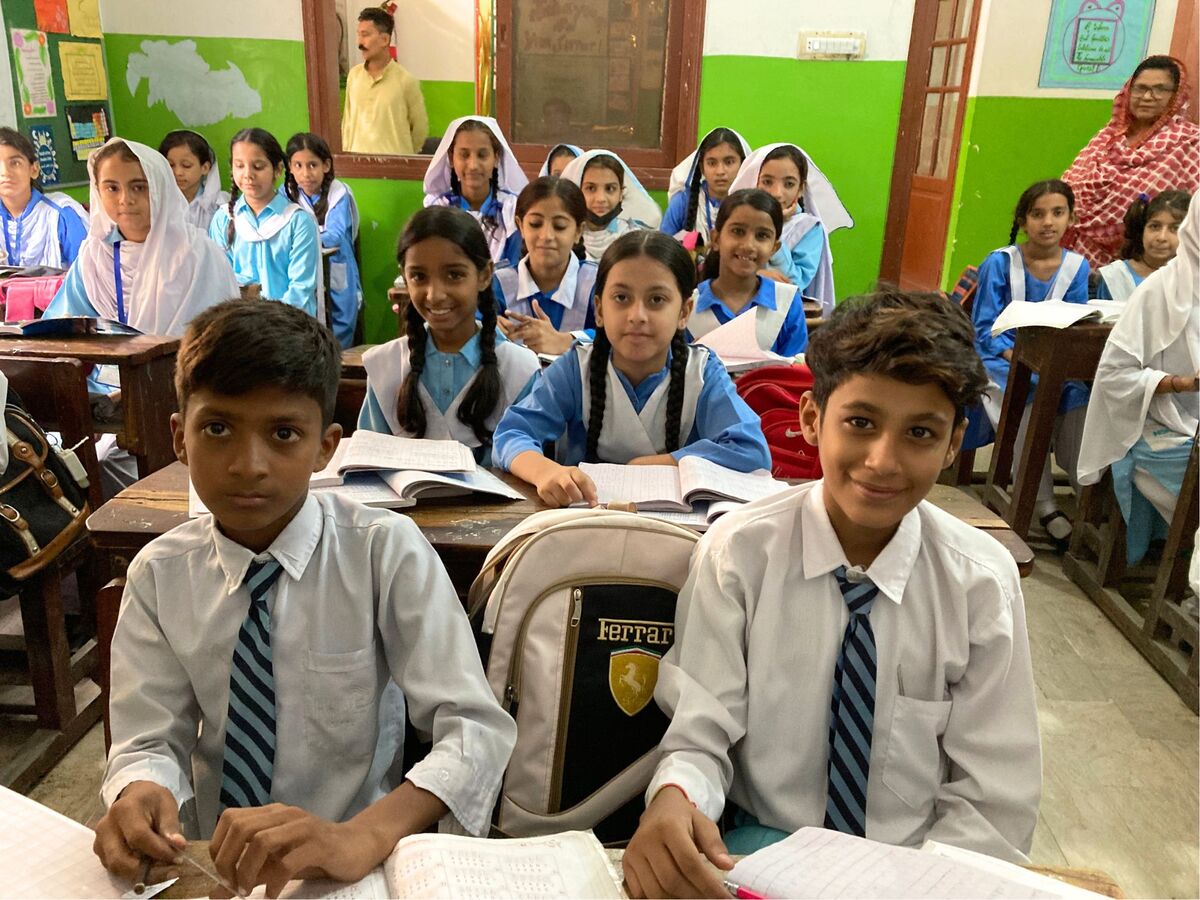
In August 2023, our founder traveled to Karachi and got a verbal agreement with Hope, an NGO that runs schools and hospitals across Pakistan, to implement our curriculum at their Zia Colony school once development is complete. We're starting with English-medium schools while building partnerships with PILL and the University of Punjab for Urdu scale translation.
Students at a school in Karachi. Hope has agreed to implement the curriculum at their Zia Colony school once it's complete.
Our curriculum is delivered in regular short lessons across the school year, not as a one-off workshop or assembly. Each lesson combines short instruction with hands-on practice: worksheets, role-plays, pair work, group activities, and structured dialogues.
Foundational skills (naming emotions, basic communication, gratitude) are revisited every year. More advanced topics are staggered across grade levels, so students experience the full curriculum across multiple years without overwhelming the academic calendar.
The result is something closer to how children actually learn: small inputs, daily repetition, gradually deepening complexity. Skills move from conscious effort to automatic habit.
Curriculum development, peer review, scale translation, and pilot delivery all cost money long before any child sees a lesson. If our approach makes sense to you, the most useful thing you can do is help fund the next milestone.
See how to help →